Fashion's Great 2025 Reset
“After years of overwhelming social media frolics, stealthiness is back in vogue. Understated is the mood; the overall vibe is lowkey.”
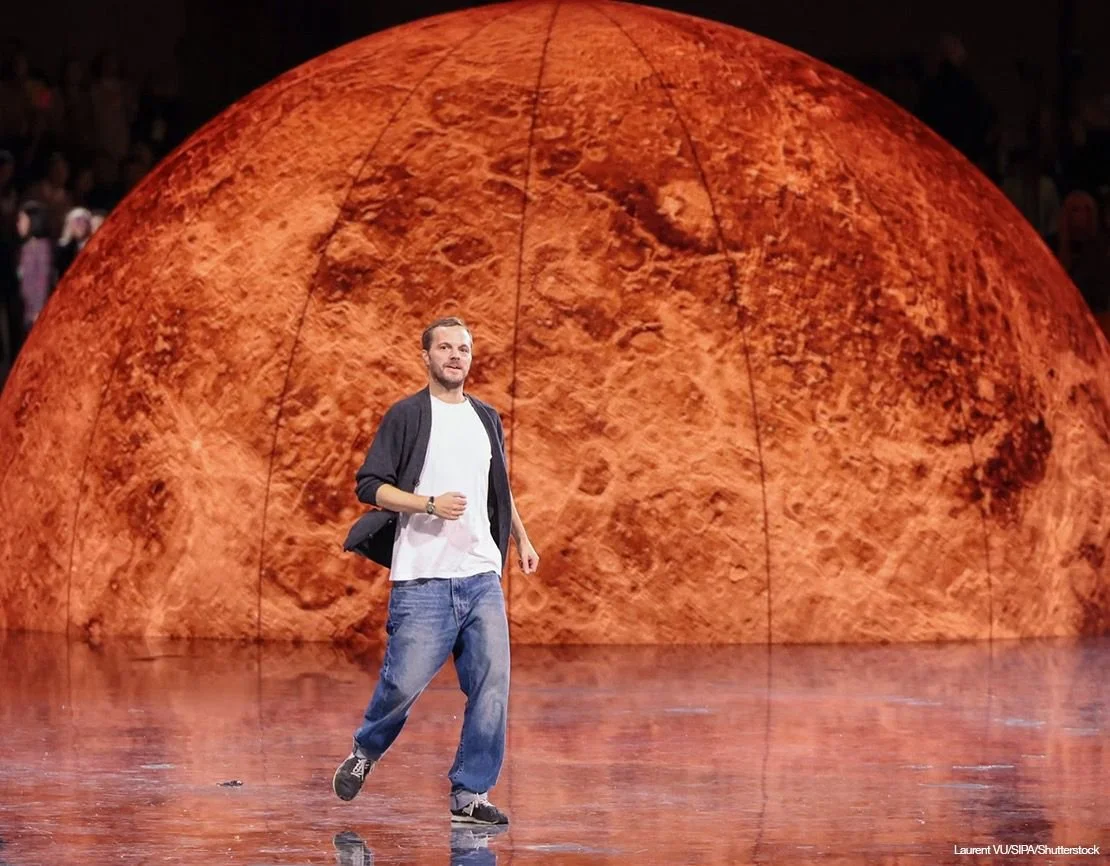
Mathieu Blazy takes a bow after his Chanel debut.
After more than a decade on Zoloft, fashion finally woke up to the times in 2025. Amid seismic changes all across the landscape, last September designers came out with a reset, with ateliers delivering some of the most solidly grounded collections in more than a decade, and executives betting on new formulas to make it through stormy weather.
“The September to Remember…”
…as some fashion editors have come to call it, was a flurry of strategically appointed talent at the helm of some of the biggest luxury brands: from Dario Vitale’s short-lived Versace, Louise Trotter’s Bottega Veneta, Proenza Schouler’s Jack McCollough and Lázaro Hernández’s Loewe; Jonathan Anderson’s full proposition at Dior; Simone Bellotti’s Jil Sander, Pierpaolo Piccioli’s Balenciaga, to Mathieu Blazy’s now historic passing of the torch at Chanel.
This season signalled less a search for spectacle than a collective recalibration. Design teams and creative directors demonstrated that smart, thought-provoking clothes could be designed with the current philosophy of dressing in mind: a style maturity, a sartorial self-awareness that translates into pragmatic and careful attention to line, form and proportion. This comes just in time to meet a generation already exhausted by excess.
Us Millenials, we like our clothes oversized because our grasp of reality is really small. We love elevated workwear because we’ve been programmed to search for meaning and identity in our job(s). Some people call it ‘quiet luxury,’ I say let me breathe from the performance of every day.
It’s a light trench coat. Pressed Japanese denim. adidas Sambas. A high-quality, base-colour organic cotton crewneck. The logo-cap from the fancy deli from around the corner—because, you know, someone has to support the local economy.
After years of overwhelming social media frolics, stealthiness is back in vogue. Understated is the mood; the overall vibe is lowkey.
One of the November Letters from the Front Row described it best: “The new cool is not needing to be seen. It is choosing when you exist in public. It is choosing who receives access. It is understanding that your life becomes richer when it is not always observed.”
The Paradigm Shift
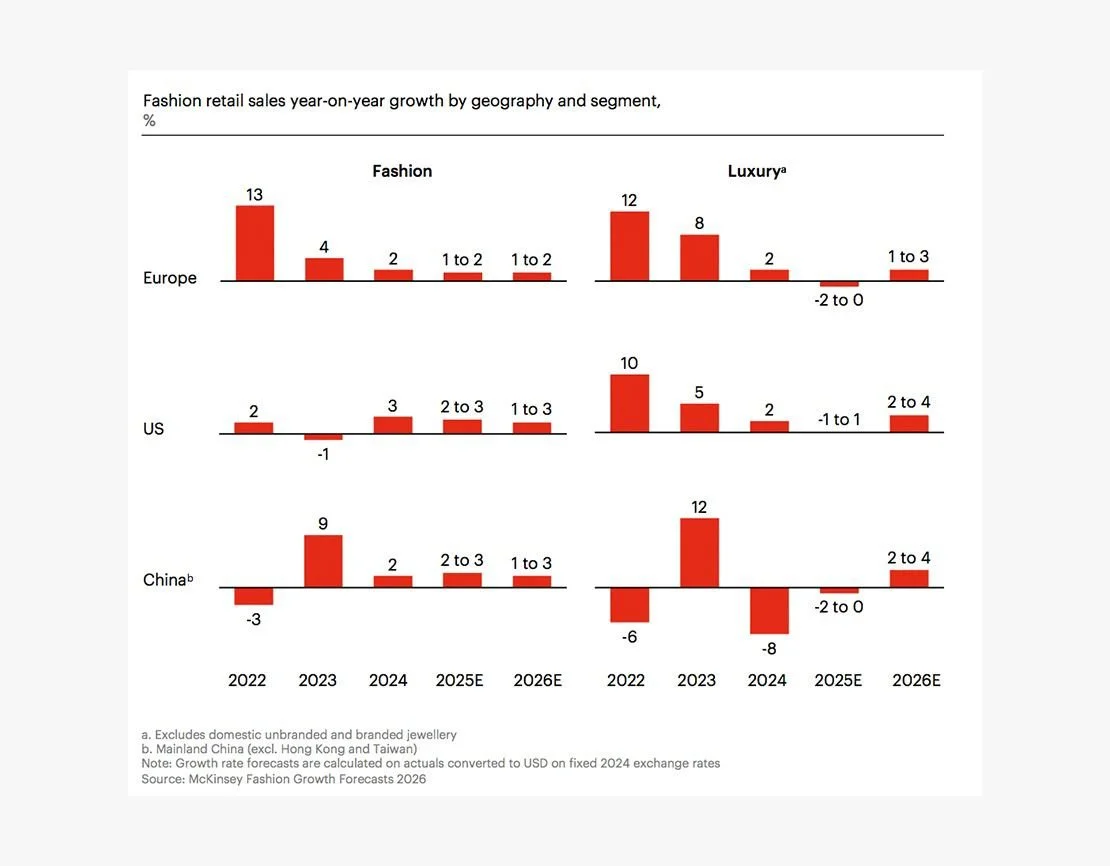
This aesthetic shift isn’t just philosophical. It’s also economic. Taste rarely changes alone; it follows money—or the lack thereof.
Last August, Montreal’s SSENSE filed for bankruptcy. More recently, Saks, one of the most iconic luxury department stores in the US, also filed for Chapter 11. Across the pond, Chanel experienced a 4.3% decline in global revenue in 2024, as reported in its most recent fiscal analysis (published in May 2025).
With tariffs redrawing the global trade map and post-pandemic inflation still causing price hikes (CNN reported last summer that prices in the luxury segment went up 52% in the last six years), a reassessment of values has come into effect.
Values that ring more Phoebe Philo than Demna, and meant to satisfy the needs of the new bourgeoisie, the “Aristo Youth” Jonathan Anderson referred to for his new Dior, the new moderns from Vincenzo Latronico’s latest novel, Perfection, a sharp portrayal of contemporary existence told through the experiences of two Millennials approaching their forties.
Interestingly, amid this tectonic shift, mid-segment brands have been doing more than fine.
Coach’s CEO, Joanne Crevoiserat, footnoted her 2025 as a “breakout year”, reporting an annual revenue of $5.6 billion, propelling its holding, Tapestry, to surpass the $7 billion mark.
Inditex, the retail giant behind Zara and Massimo Dutti, closed its fiscal year with $19.69 billion in annual revenue.
A direct-to-consumer approach and the incursion into different price tiers (Coachtopia, the sustainable and accessible line targeted at GenZs) made a big part of Coach’s 10% annual growth. As for Inditex, its centralized data processing and inventory optimization strategy, its ability to pivot, and its expansion into 39 new markets have proved to be key.
To cite The State of Fashion 2026, the mid-market has topped luxury as fashion’s main value creator.
An Epidemic of “Nice Clothes”
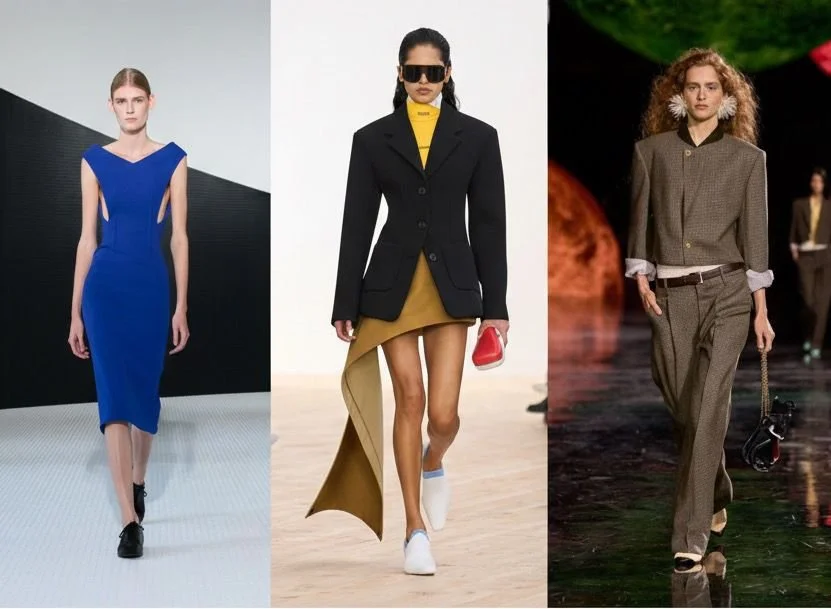
From left: key looks from Simone Bellotti’s Jil Sander, Jack McCollough and Lázaro Hernández’s Loewe, and Blazy’s Chanel.
So what exactly does this force designers to do? Well, turn their heads to where the customer is willing to put their money in, and right now that means well-executed, smart, versatile clothes for life, more than for costume. Brands and designers are now obligated to add an extra layer of value to their products to justify the outrageous prices, and, judging by the last September collections, it seems like empathy and practicality have been the values that designers have agreed on imbuing clothes with.
Still, this neo-Formalism is a compromise that a corner of the industry (and the Internet) is unwilling to take, seeing it almost like a betrayal of the very integrity of what fashion has come to represent: grandeur, ostentation, dream-like sequences, a heightened version of ourselves—the very own aspirational energy that makes the world go round.
Eugene Rabkin, in a recent BoF op-ed, “The Epidemic of Nice Clothes,” argues: “What do nice clothes make us feel? Not much. The comfort they offer is like a sartorial tranquilliser. But perhaps we shouldn’t be surprised at their current popularity — not when pastiche has become fashion’s main mode of creation and the industry has run out of things to copy.”
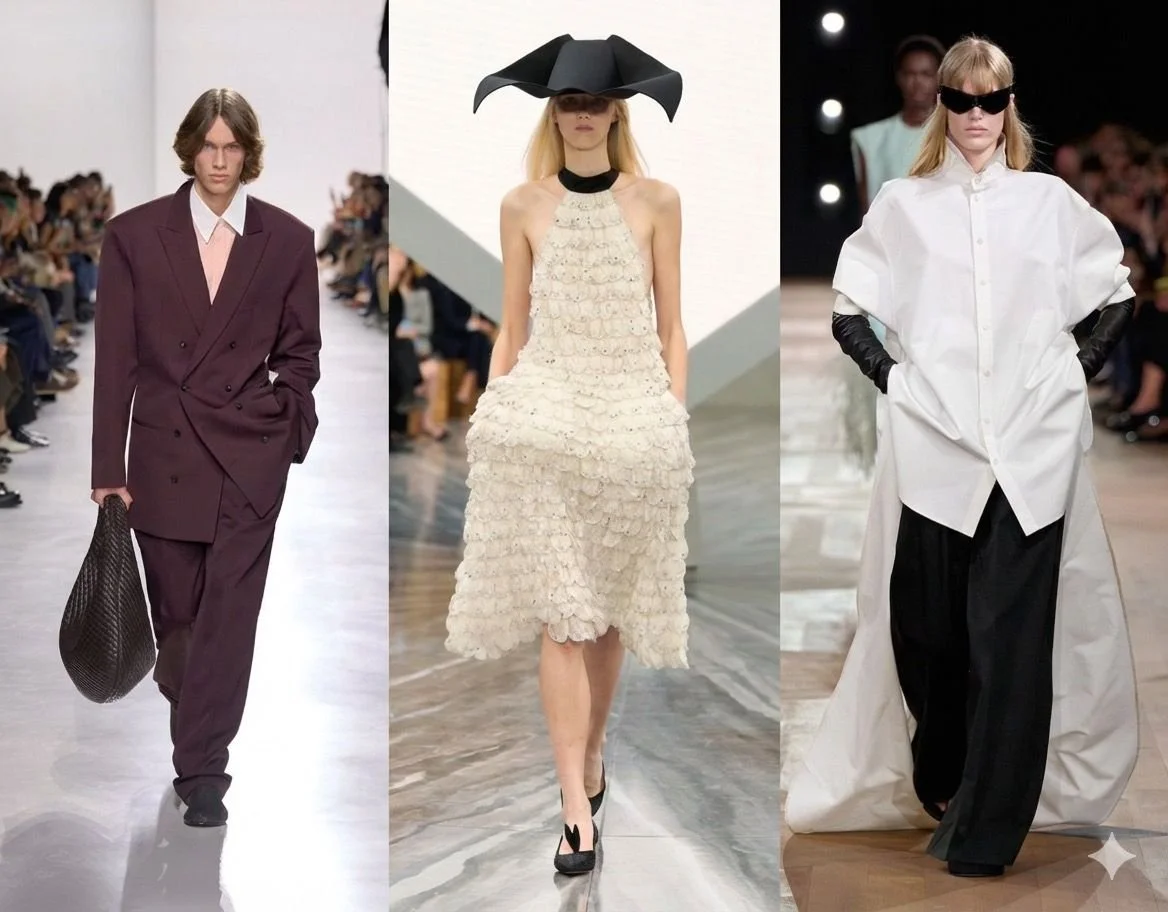
From left: key looks from Louise Trotter’s Bottega Veneta, Jonathan Anderson’s Dior, and Pierpaolo Piccioli’s Balenciaga.
And I get it. I also grew up with this mindset of fashion as a medium for maximum self-expression, as a self-defence weapon, as the speaker through which I could shout my thoughts to the world, but with time and the maturity it has blessed me with, I’ve learned that there are also important silent battles that fashion can mediate.
The truth is, this is not the first time such a style shift has been experienced so suddenly. This is history repeating, and coming into a full circle from a revolution that first took place in the last decade of the 18th century, when, after the fall of the Ancien Régime, the nascent bourgeoisie purposefully distanced itself from any type of ornament. A social phenomenon coined by the British psychologist John Flügel as The Great Male Renunciation in his 1930 canonical book, The Psychology of Clothes.
After heads were chopped in the guillotine, and all the men in wigs, wearing taffeta capes and dramatic jewelry, peacocking fashion became a sour memory, synonymous with anti-progressiveness and supremacy. This was the reset that ultimately gave us the tuxedo, the tie, black-on-white-on-navy, utilitarian dressing, and—wait for it—pragmatic and careful attention to line, form and proportion.
So, to counter Rabkin’s argument: no, we’re not taking a ‘sartorial tranquillizer.’ In any case, we’re flushing any chemical sedation and instead choosing to dress up instinctively.
We’re tinkering with traditional values and reappropriating them to make our own. We’re abolishing the rigid canon that decades of conspicuous consumption and online virality left us with, and choosing perhaps the most revolutionary thing you can do in fashion: to simplify.