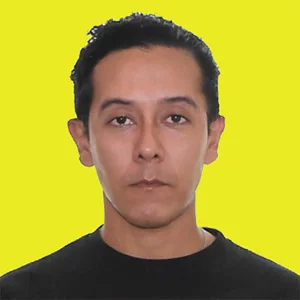
Hey Pride, are you still there?
"While on the TV three hunks engaged in a clumsy case of double penetration, I struggled to find the right words to describe how I'd been feeling lately—as if my queerness no longer measured."

35mm by Mauricio Herrerabarría. Autumn 2024, Montréal
Summertime in Montreal calls for terrace gossip.
Sure, we can go to Park Lafontaine or Jarry, but nothing beats a comfortable seat at a local bar with bathrooms and an overpriced drinking menu at hand. A passive activity that always makes me feel an inch closer to my ultimate fantasy: lounging in the lanai with Blanche Devereaux.
It was a hot summer afternoon, like any other. Two iguanas under the sun, a friend and I made the best of the cinq-à-sept (the French Canadian for happy hour) at Bar Le Stud. After a couple of beers, while on the TV three hunks engaged in a clumsy case of double penetration, I found myself struggling to find the right words to describe how I'd been feeling lately—as if my queerness no longer measured.
To be a saint means to be myself, Thomas Merton once wrote. A thought that unfolds like a Russian doll—you peel, and you peel; unfold and unfold, until its authentic meaning finally reveals itself. Or, does it really?
“Queerness is not a competition”
Rounding up my third—or maybe fourth… who’s counting?—Blue Moon, I finally admit to my friend that a big part of my insecurity is triggered by how performative and shallow queerness has become.
Everything’s an aesthetic, a trend. A sort of pantomime, I burp, trying very hard (clearly!) not to be that finger-wagging faggot.
Well, queerness is not necessarily a competition, Mauricio… my friend replies.
And I get their point.
But in practice, it feels otherwise.
Wearing sweatpants and old t-shirts, come Sunday morning, we sit on the couch to watch RuPaul reruns; we judge queerness as if we were on a dog show. We dissect and categorize. We compartmentalize identity, the wig, the makeup, the fashion; the serve—the ruveal.
On the street, it’s the armband (‘fisting’) tattoo; the perfectly-coiffed mustache, or curls; the scruffy mullet and chipped painted nails; the muscles erupting from a mesh crop top; the little earring dangling from the right earlobe; the jockstrap peeping out from them tight shorts.
‘Representation matters,’ we repeat, as if it were some sort of incantation that would prevent families from kicking folks out of their homes. As Guy Debord argued in The Society of the Spectacle, we’ve grown so dependent on these representations, on simulacra, and now we struggle to discern — and engage — with reality.
Like Narcissus, obsessed with a reflection — a representation, every day we disappear into a dark surface.
Id Quod Sum
Throughout the months of writing this text—I’ve been massaging these paragraphs since June 2024—the word authenticity has resonated within my four walls multiple times.
What is it? A value? An aspiration? And, what does it represent nowadays?
Authenticity, at least to me, is an ideal that will always continue to morph according to each person and each of their realities. A promise to stand by and for.
If we travelled in time to the 1950s and asked someone about it, their answer would probably come imbued with a nationalistic, heroic, and even hopeful tonality. Back then, authenticity was a collective virtue society clung to to reconstruct a world weakened by the two world wars.

La Liberté Guidant le Peuple, Eugène Delacroix, 1830. Part of the permanent collection of the Musée du Louvre, Paris.
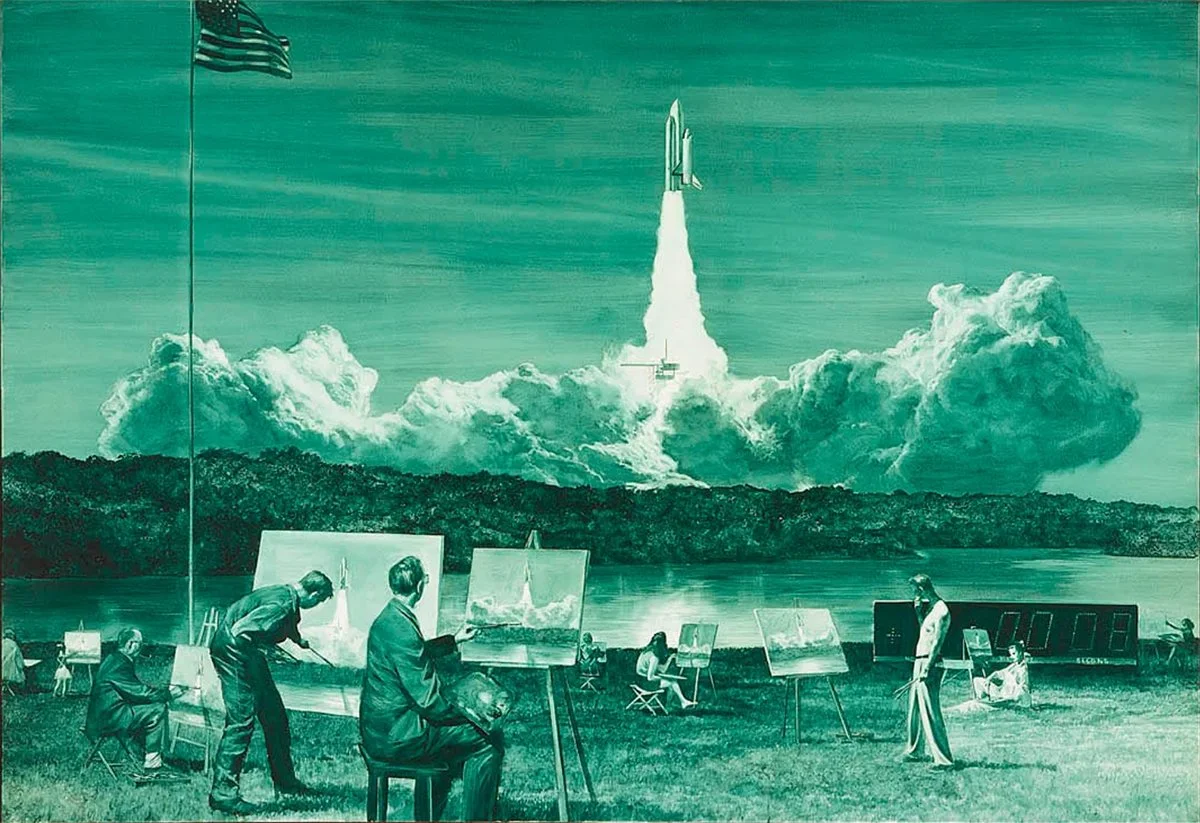
Action Painting II, Mark Tansey, 1984. Part of the Intl. Contemporary Art Collection of the Musée des Beaux-Arts de Montréal.
Now, same question but ten years later, as the counter-cultures and social movements of the ’60s disrupted the social order, and the answer would probably depict authenticity as a main character in a revolutionary tale, igniting change. As the world shifted, authenticity turned into a force, a catalyst for transformation. “A vector for mobilization,” as Gilles Lipovestky described it in Le Sacré de L’Authenticité. “Non-conforming, anti-institutional.”
Ever since then, the individual has remained as authenticity’s chief petri dish. Deeply intrinsic, it is now something we feel entitled to. A Mexican restaurant where no one speaks Spanish? I find that completely insulting, for example.
Lipovetsky calls this latest iteration Personal Authenticity: a blue checkmark that’s up for purchase. Today, everyone’s a two-step process from legitimacy.
“The properly philosophical life consists in transforming oneself by rejecting false values, freeing oneself from everything that is foreign to us (wealth, honors, whims of desire and passion, conventions of social and political life...) in order to achieve independence, inner freedom, and peace of mind, which are the distinctive traits of wisdom."
— Le Sacre de L’Authenticité, Gilles Lipovetsky, Gallimard, 2021.
“La vie proprement philosophique consiste à se transformer soi-même en rejetant les fausses valeurs, en s'affranchissant de tout ce qui nous est étranger (richesses, honneurs, caprices du désir et de la passion, conventions de la vie sociale et politique…) afin d'atteindre l'indépendance, la liberté intérieure, la tranquilité d'âme qui sont les traits distinctifs de la sagesse."
I’d say we will never really know what real authenticity actually means. Because, as cliché as it may sound, it’s about coming to terms with the possibility of never getting an answer. It’s about continuing to ask the questions, relentlessly and curiously: What does authenticity mean? And when do I feel the closest to it? With no wrong answers, we’re all just dancing somewhere between the two extremes of the pendulum.
As for me, I come the closest to it by approaching change not as my enemy but as an opportunity to explore the many versions that I can be, and the many places that I can inhabit. Instead of remaining on the flattening preconception of just “living my truth,” I work every day on flourishing in the plurality of my self-deceptions because it’s there where I can invent new futures, new possibilities, and new values.
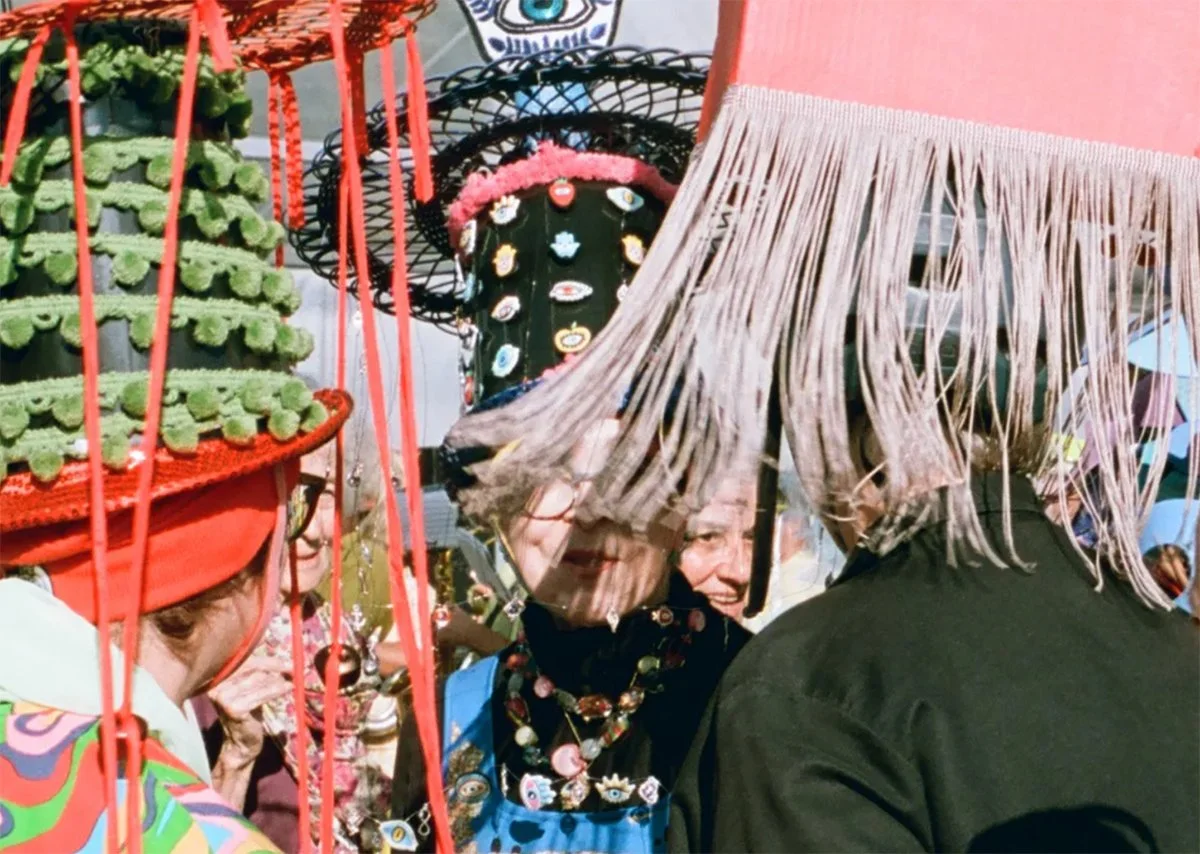
35mm by Mauricio Herrerabarría. Autumn 2024, Montréal.
Life in Oscillation
Four chairs around a table in a warmly lit kitchen in Villeray. Winter is in full swing, and the gossip has migrated indoors. A friend passes me the soy sauce; it’s sushi night and the vegan sashimi is off the charts.
The conversation stays around dating and the difficulties of finding someone interesting, not just eye candy.
I’ve lost track of time, between cider and wine. The room, completely sequestered by rapturous laughter. Everyone’s at the table, no measures.
Gold dust thickens the air. This is where I now feel and find myself to be my queerest, surrounded by friends and good food, all oscillating between the best and worst versions of each other, nipping at them. No need to make impressions; no performance. In my warm socks and snuggish sweater, I can put myself forward, make fun of myself, and enjoy the moment.
Why the fuck would I wanna be a saint, when I can just be here.
Further Readings
Debord, Guy. The Society of the Spectacle, Zone Books, 1967.
Lipovetsky, Gilles. Le Sacré de L’Authenticité, Gallimard, 2021.
Tilda Swinton on queerness and authenticity, Fresh Air, NPR, 2025: https://www.npr.org/programs/fresh-air/2025/01/08/fresh-air-for-january-08-2025